
Iris van Herpen’s Sculptural Couture Responds to Nature at the Brooklyn Museum
From Beyoncé to Björk: Iris van Herpen's Brooklyn Museum exhibition, "Sculpting the Senses," unfolds across eleven themed chapters on view through December 6

Walking into “Iris van Herpen: Sculpting the Senses” at the Brooklyn Museum, visitors first encounter the Seijaku dress (2016), its surface encrusted with hundreds of glass bubbles that float around the body. A version of the dress was recently reworked for Eileen Gu at the Met Gala, but here it stands before a frozen wave by 目 (Mé), as Salvador Breed’s soundscape resonates through the galleries. The garment is closer than a museum object should be; van Herpen wanted it that way.
“I really pushed how close I could bring the audience towards the garments,” the Dutch couturier tells Galerie. “The museum was quite scared, I guess. Theoretically, people are so close that they can touch the work—and that’s what I wanted. The closer the better.”
On view through December 6, “Sculpting the Senses” is van Herpen’s first major American show. It is also the first to place her 140 haute couture creations alongside works from the Brooklyn Museum’s collection, fossils from the American Museum of Natural History, and specimens from the Yale Peabody Museum and the Staten Island Museum.
Since launching at Paris’s Musée des Arts Décoratifs in 2023, van Herpen continued to evolve the show. Looking back, she asserted, has pushed her forward. “When [the Paris] exhibition opened, I started working on these aerial sculptures,” she says of Weightlessness of the Unknown (2024), which makes its debut here. “I’m sure it had to do with going back into my work—feeling the need to translate that into a more aerial perspective… zooming out to capture a bird’s eye view.”
Curated with Matthew Yokobosky and Imani Williford, this is the largest and most personal iteration yet. Van Herpen describes the months spent combing through archives of her Amsterdam atelier as “like going through my diary, and then picking the ones to live here.” Eleven themed chapters unfold in her chosen order, moving from water to cosmos, with stops at anatomy, fear, growth, and flight.

1. Water and Dreams
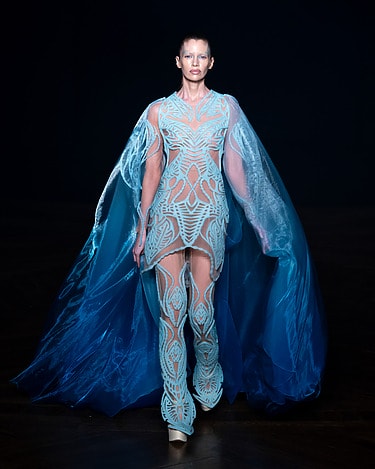
The diary opens in water. And in van Herpen’s hands, water behaves like a dream, slipping between states. It pours into glass, hardens into fabric, blooms into something almost alive. Past the Seijaku, water continues to find new bodies through the Water dress (2010), molded from heat-treated PETG; the Dimensionism dress (2020), made with Sirius glass blown by Austrian master Bernd Weinmayer; and the Sumimagashi dress (2019), worn by Grimes in her “Violence” music video. Central to this chapter is the Living Algae look (2025), created with biodesigner Chris Bellamy from 125 million Pyrocystis lunula algae cultivated in seawater baths. Alive inside a misted glass case, the piece emits light when the wearer moves.

2. Sensory Sea Life: Lady Gaga’s Hydrozoa Dress
The next room submerges the body. Hydrozoa (2020), made with artist Shelee Carruthers in glass organza, was worn by Lady Gaga while promoting her Chromatica album. Beside it, the digitally printed organza circles, heat-bonded to laser-cut fabric dendrites, of the Hydromedusa dress (2020) wrap and undulate the body like a jellyfish in motion. Van Herpen’s dance background is everywhere here, with each silhouette engineered for the body to swim through it.

3. Forces Behind the Forms
The third room narrows in toward the architecture inside living things. From the geometries of radiolarians to the prismatic cells of honeycomb, the garments here draw on morphogenesis, the process by which bodies build themselves. Van Herpen studied Ernst Haeckel, the 19th-century biologist who drew microscopic life in obsessive detail. The Empyrean dress and gown (2021), developed with paper sculptor Rogan Brown for her Earthrise collection, mimic the coral on Haeckel’s pages through laser-cut recovered ocean plastic.

4. Alchemical Atelier: The Amsterdam Studio in the Rotunda
In the rotunda, van Herpen’s Amsterdam studio seems to have landed inside the museum. She calls her method “craftolution,” a fusion of craft and evolution: handwork alongside 3D printing, embroidery alongside laser-cutting, and failure alongside discovery. Sample boards crowd the walls with pleated folds, silicone webs, branching laser-cutouts, and printed organza. Microscopes invite visitors to look closer, while hours of unedited atelier footage play across cascading fabric panels.
Most of the room’s inhabitants began as rejects. “On the board here, you see lots of samples that have failed, basically, that did not become a dress in the end,” van Herpen says. “But, to me, they are a starting point. Each one is sort of the beginning of a new idea.”
In a corner, the Radiography dress (2014), made with multidisciplinary designer Philip Beesley after they visited the European Organization for Nuclear Research, is a honeycomb of laser-cut PETG cones joined with silicone. Beside it, Tomáš Libertíny’s Seed of Narcissus (2025) is a crystal cocoon coated in beeswax honeycomb, built over months by thousands of bees. One honeycomb is cut by lasers in a studio. The other was built by the creatures that invented it.

5. Synesthesia
Van Herpen sees sound. Music appears to her as a pattern, a mild form of synesthesia that runs throughout the exhibition. Breed, her collaborator of 17 years, composed the soundscapes that animate each gallery, each composition based on the room’s theme. “When I work on textures and materials, he’s able to translate that into a sound,” she says. “There’s no one else who can do it so precisely, because he knows me so well, and he understands the themes so deeply.”
This crossover becomes visible in Dichotomy (2019), whose concentric lines echo sound waves. Beside it, Naum Gabo’s Linear Construction in Space No. 2 (1969), a sculpture made from taut nylon filaments stretched into curving planes, offers another version of visible vibrations. Across the room, the Bene Gesserit gown (2021), created for Grimes and named after the Dune sisterhood that weaponizes sound, uses ripples of mirror mylar and silicone to catch light the way air catches sound. It faces Enrico Ferrarini’s R-Evoluzione (2014), a ceramic figure caught mid-transformation, its body twisting and hands shielding its ears as if sound shrieked through it.
“It’s really about bringing the senses together. That’s what synesthesia is,” she says. “Apparently, we all have it when we’re really young—at one year old, our senses are all connected. I think art can stimulate that.”


6. Skeletal Embodiment
A 180-million-year-old marine reptile fossil from the American Museum of Natural History stretches along one wall with three garments facing it like distant descendants. The Skeleton dress (2011), copper-electroplated and 3D-printed with the architect Isaïe Bloch, splays open at the ribs. A 50-million-year-old stingray and an 80-million-year-old herbivorous dinosaur rest nearby.
Artists from Michelangelo to Thomas Eakins studied écorchés, flayed anatomical models that exposed bodies’ inner architecture. Van Herpen does a related kind of looking, then turns the hidden structures outward as exoskeletons. After years of collaborating with biologists, she pulls from any body: fossil, fish, dinosaur, plant. “Through our daily lives, we tend to separate ourselves from nature. But we have animals, plants, and humans—and obviously, we’re all one. The idea I once had of myself is just not true.” She tells Galerie that this came in part from James Lovelock, the scientist behind the Gaia hypothesis. “He explains that the world is one organism, and that makes us part of a larger body, just as the microorganisms within us are part of a larger body.”


7. The Mythology of Fear: Scarlett Johansson in the Bird Dress
Here, the body becomes a bird, a snake, maybe a chimera. The Bird dress (2013), worn by Scarlett Johansson for Vogue México, is hand-sewn from countless layers of laser-cut Dragon Skin silicone over ivory cotton, with three 3D-printed bird skulls emerging from its “feathers.” Nearby, the Alchemic neckpiece and skirt (2008) and Snake dress (2011), worn by Björk on tour, sheath the body in dark scales and metal.
Fear, for van Herpen, begins when a body stops being itself. In darker moments, she often returns to the world of Hieronymus Bosch, whose Dutch hometown neighbored her own. “Bosch really taught me the duality of the positive and the negative,” she says. “He has these utopic worlds and these demonic worlds—and they are part of a whole. When you look at The Garden of Earthly Delights, it’s a beautiful painting; you have these worlds, but you can close it, and then it becomes one all-encompassing world. There’s beautiful philosophy in his work that I refer to and keep coming back to.”

8. Growth Systems
This chapter traces van Herpen’s fascination with the unseen infrastructure of growth and with the dendritic networks linking the organic world to man-made design. Whether in tree roots, mycelium, coral reefs, Gothic stone arches, cathedrals, or forests, she finds systems that branch with the same logic. The Cathedral dress (2012), made in collaboration with Isaïe Bloch and the Belgian 3D-printing firm Materialise, reimagines Gothic architecture in copper-electroplated polyamide, emulating the warm patina of waxed wood. Placed next to a 19th-century Gothic-Revival chair from the museum’s collection, the garment reveals a shared reliance on pointed vaults to disperse weight outward, like a tree extending its canopy. Stepping even closer to soil, the laser-cut eco-leather lace of the Luminous Lichen gown (2021) maps the sprawling, cooperative pathways of fungal networks across the body. For van Herpen, old craft and new technology are extensions of the same natural intelligence.


9. Cabinet of Curiosities
Inside glowing glass, iridescent morpho butterflies, saturated beetles, and scientific illustrations by Ernst Haeckel and Émile-Allain Séguy gather with a 1732 copy of Ovid’s Metamorphoses and a cowrie-shelled, bridal mask from Papua New Guinea. Each curiosity feels like an artifactual testament to van Herpen’s obsession with shape-shifting. In Harold Edgerton’s multi-flash photograph of dancer Gus Solomons Jr., rapidly moving limbs blur into a wing-like sequence, human choreography mimicking biological anatomy. Picking up on similar animalistic motion, the Coenesthesia headpiece (2018) articulates with the precision of a centipede, while nine surrounding runway videos project van Herpen’s muses in perpetual motion, echoing the dancer’s fluid transformations.


10. Cosmic Bloom
In the final rooms, the physical world seems to yield to the infinite. Here, visitors pass through Rob Wynne’s Extra Life (2022), a celestial field of mirrored glass discs, into a realm where mannequins hang at angles that forget gravity. On a vast screen, French world-champion skydiver Domitille Kiger dances through the atmosphere in a billowing blue Earthrise gown (2021).
“They’re things about exploring freedom,” van Herpen notes. “I’ve been doing skydiving myself, and to me, it’s really a reset—you feel your own fragility and let go of all your daily thinking.” Kiger, she adds, “really dances into the sky. As a dancer myself, that would be my ultimate freedom. If you can dance in three dimensions.” In this room, the designs come alive, couture unburdening the body to briefly levitate beyond earth.

11. New Nature
The final chapter pushes van Herpen into a post-human landscape, exploring the blurred boundaries of nature and artifice. Syntopia (2018) appears to flutter even in stillness, its sheer organza petals layered over a delicate armature, suggesting a bird’s wing caught between beats. Nearby, the soft pink Loïe dress (2026), named for dancer Loïe Fuller, fans like fabric mid-twirl, while Beyoncé’s Heliosphere gown (2023) from her Renaissance World Tour rests centrally in the room with a star-power all its own.
A wall of portraits shows Lady Gaga, Tilda Swinton, Rihanna, Cate Blanchett, and other iconic women wearing van Herpen’s designs, turning the room into an alternative red carpet of sorts. This room echoes the “feminist meaning to the exhibition” van Herpen cited to Galerie. “My work is actually a way of expressing my own feminine perspective towards an industry where there is too much male domination on the question of ‘what is femininity?’ Within fashion, there has been way too much focus on the outside beauty of a woman—but the real beauty is on all sides… My work also talks about the intelligence within us. It’s not just about wearing a garment for its beauty, but about wearing it to express who you are, how you are transforming, and where you want to go. Fashion needs women to bring that deeper conversation into its history.”

By the exit, the advantage of seeing van Herpen’s work in a museum setting is clear: time slows down. On a runway or red carpet, her garments flash by in a transient surge of motion. Here, they can be studied. “In an exhibition, you can spend an hour in front of a garment, and that’s when something starts talking to you,” she said. Across eleven chapters, her designs transform into fossils, waves, skeletons, fungi, wings, sound waves, machines, and myths, never settling into one category for too long. Van Herpen seems equally uninterested in fixed classifications. “I want to go through life discovering new stories and new ways of looking at life,” she says. “I don’t hold onto sort of one truth or one belief.”
“Iris van Herpen: Sculpting the Senses” is on view at the Brooklyn Museum through December 6, 2026.