
A Landmark Calder Exhibition with Over 300 of His Revolutionary Works Goes on View in Paris
“Calder: rever en equilibre” is on view at Fondation Louis Vuitton until August 16, 2026

In 1956, Alexander Calder made a cake for his mother’s 93rd birthday. Cute and round with a candle on top, instead of chocolate and sponge, it was made of tin cans, aluminum pieces, and wire. With the candle lit, spiny wire arms hung with crudely cut metal discs would start to dance. We have no record of Mrs. Calder’s response, but today the cake sits in a vitrine, in an exhibition at the Fondation Louis Vuitton in Paris dedicated to the artist’s work.

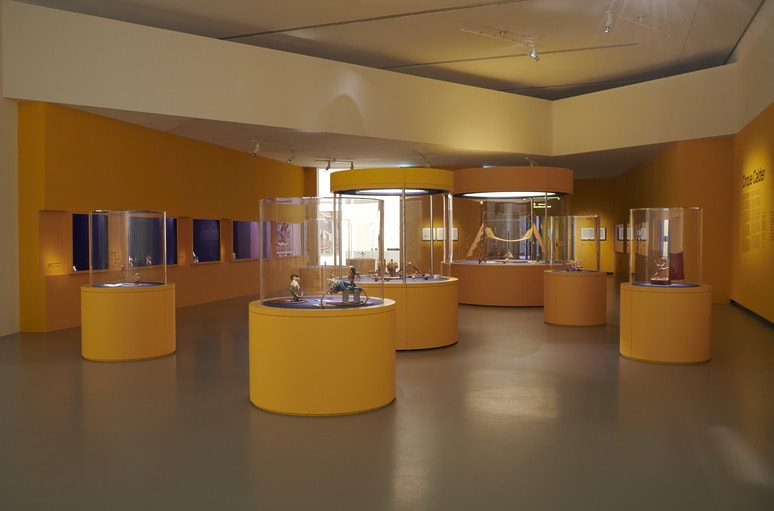
“Calder: rever en equilibre” is an immense show of over 300 artworks, many with the same lightness and humor as the birthday cake. The title, translating roughly as “dreaming in balance,” might refer to the delicate suspended mobiles for which the American artist is best known. Here they are plentiful—black, red, grey, and white— dancing in a dainty ballet throughout the galleries of the Fondation building. There are huge abstract but anthropomorphic sculptures that prowl across the floors. And a show within a show of 50 pieces of hand-wrought jewelry, mostly made for and worn by his wife.
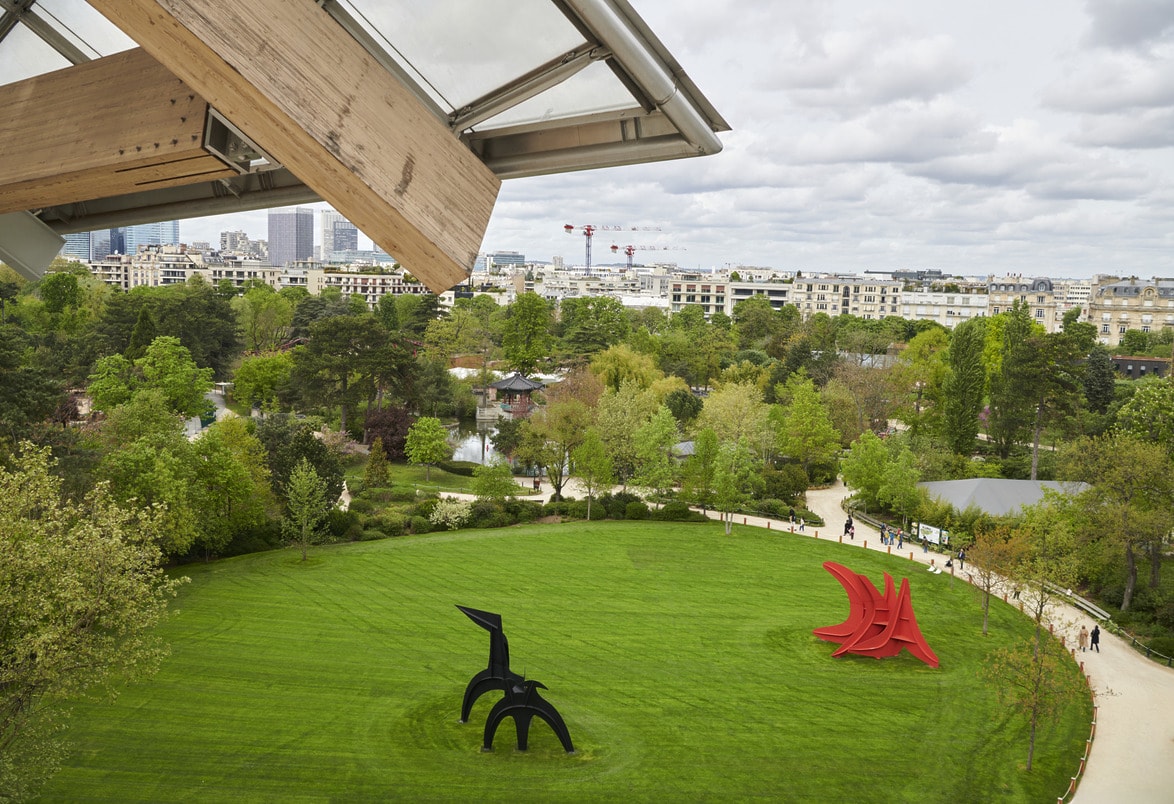
Outside the building—Frank Gehry’s dramatic explosion of swooping glass sails that opened in 2014—and on a dazzling green lawn, sit two monumental works, one black, one red. “It’s the first time the Fondation has installed work outside,” says Calder’s grandson Sandy Rower, who set up the Calder Foundation in 1987 and has protected his grandfather’s legacy ever since. “I recommend you take the path to the far side and look back and see the sculptures in relation to the Gehry building. They really enhance each other.”


One of the sculptures, the brilliant red Five Swords made of both sharp and curving steel plates, looks like a jagged vermillion Hokusai wave. It was made in the last year of Calder’s life, in 1976, but the story of his public sculpture goes back to 1937, when he installed the Mercury Fountain at the Spanish Pavilion at the Paris World’s Fair, where the centerpiece was Picasso’s Guernica. The Fountain is shown here in maquette form inside the building—an assemblage of plywood, paperboard, and tin, the mercury that would drip onto its waterlily-like petals represented by puddles of silver paper. Even in this reduced presence, it is as joyous as the real thing.
Public sculpture had been about imposing larger-than-life figures—cast in bronze, or carved in stone—until Calder came along. His work was big, but it was abstract, and about space and form, geometry and dynamism. “It was non-denominational, non-political, non-religious,” says Rower. “He wanted to make your life better, to raise a smile or an exclamation. He believed in art as democracy. He loved a public forum where 1,000 people would get right up close to his work.”

Calder was born in Philadelphia in 1898 to parents who were not just artists but the children of artists. In a bid to escape the inevitable in his own career, he trained as an engineer. But the ruse failed. By 1926, he had moved to Paris and became fully engaged with its avant-garde. “Calder’s Circus,” which he toured from 1926-1931, is the exhibition’s opener—a panoply of tiny figures and set designs, made from paper, cork, fabric, and wire, that Calder would animate in public performances, while his friend Isamu Noguchi wound up the phonograph for the soundtrack. (Catch it while you can. With some figures taken from private collections and the rest belonging to the Whitney in New York, and all of them highly fragile at the age of 100, it will never be reassembled again.) It proved catnip to the city’s artists, and he joined their ranks.


Calder began to fashion his suspended works of wire and metal discs, and they were named “mobiles” by the scene’s most significant voice, Marcel Duchamp. Jean Arp countered that by calling the static sculptures “stabiles.” Jean-Paul Sartre, then the most famous writer in France, if not the world, wrote the 1946 catalogue essay for the first show Calder staged in Paris, when he returned there after the war. “They feed on the air, breathe it, take their life from it,” said Sartre of the mobiles. Joan Miro was among his closest friends.
“He revolutionized sculpture,” says Suzanne Paget, the artistic director of the Fondation Louis Vuitton. “Before, it was about volume and mass, and noble materials. Then he comes along, and he starts making the mobiles, and it’s about the void and lightness. He uses the cheapest materials like wood and wire. But he is meticulous about how the pieces work in space, and in the wind. They become a fluid part of their own environment.” Though nothing is made of it here, Calder’s engineering formation is never far away. He knows how to make, how to balance, how to create movement.

Meanwhile, he was making jewelry—exaggerated designs from bent wire, or brass, polished to look like gold. “He was partly putting down people obsessed with diamonds and platinum,” says Sandy Rower. “He was very specific that adornment doesn’t have to be about precious metals and valuable stones.” Among the works are necklaces with broken crockery set in wire mounts and an extravagant collar fashioned from L-shaped pieces of tin. There are hats and belts and crowns, and one can’t help wondering if occasionally even his wife, Louisa, a bohemian from a well-to-do family, sighed and asked “Do I have to?”


Calder had a small studio in the Loire Valley, but his primary home was in Roxbury, Connecticut. A United States native with a big footprint in Paris, it seems right that this exhibition celebrates the 100th year since his arrival in the French capital. But his final projects were all-American. In 1974, he decorated a jet for Braniff—a yellow and red body finished with a dramatic red swoosh. It was the first time an artist had been commissioned to paint a jet. And really, no surprise that it went to the one artist who wanted his work to be seen in the most public places possible. The sky, it turned out, was the limit.
Calder: Rever en equilibre is on view at Fondation Louis Vuitton until August 16, 2026.