
Hotel of the Week: A Legendary Paris Nightclub Transforms into a Glamorous Hideaway
Studio KO overhauls the erstwhile Bus Palladium into a music-infused hotel layered with cinematic interiors, a subterranean nightclub, and the rebellious spirit that once drew everyone from Salvador Dalí to Serge Gainsbourg

There’s something electric about Rue Fontaine, the storied artery cutting through Paris’s once-seedy Pigalle district. Edgar Degas kept a studio there; Django Reinhardt performed at the dance hall La Boîte à Matelots; André Breton, Louis Aragon, and Giorgio De Chirico helped conceive Surrealism along its storied blocks, around the corner from Moulin Rouge.
In 1965, one of the street’s most prominent addresses materialized when James Arch, a bebop dancer in the music halls of Saint-Germain-des-Prés, transformed the faded venue L’Ange Rouge into a raucous rock-and-roll haunt. He borrowed the name “Le Palladium” to evoke the glamour of New York nightlife and paired it with the image of a bus—an offbeat nod to his idea of shuttling suburban youth into the city to mingle freely with Pigalle’s bohemian crowd of long-haired beatniks, young women in Courrèges minidresses, and musicians in pointed boots. Ten days after opening, Salvador Dalí arrived walking a black panther on a leash; Serge Gainsbourg immortalized the club in his lyrics to Qui est in ? Qui est out ?, which he wrote on site. Jane Birkin described the atmosphere as a “mental laboratory.”
But even the most legendary parties end, and after 57 years, Bus Palladium closed in summer 2022. Yet several years earlier, building owner Christian Casmèze approached Nicolas Saltiel, founder of the hotel group Chapitre Six, with an ambitious proposition: transform the fabled nightclub into a five-star hotel steeped in art, music, and culture. Saltiel envisioned the new Bus Palladium in the spirit of New York’s Chelsea Hotel, a magnet for artists, musicians, writers, filmmakers, and curious travelers. “I want a hotel that diverges from the classic five-star model,” he explained. Few hoteliers suited the task better. Saltiel knew the Bus firsthand from his years working there, and through Chapitre Six, he has revived such storied destinations as Hôtel La Ponche in Saint-Tropez, Cap d’Antibes Beach Hotel, and Hôtel Saint-Georges with a shrewd understanding of their cultural cachet.
For the overhaul, Saltiel enlisted architects Karl Fournier and Olivier Marty of the Paris- and Marrakech-based Studio KO, whose résumé includes projects steeped in rich history: the Yves Saint Laurent Museum in Marrakech, the renovation of Château Marmont in Los Angeles, and Musée de la Mode et du Costume in Arles. “The idea was to create contrasts and make it a place connected to its DNA, marked by a certain impertinence,” Fournier said of the ambitious transformation, which pushed 46 feet underground and added five new stories alongside a restaurant, bar, and 35 vintage-inflected guest rooms.
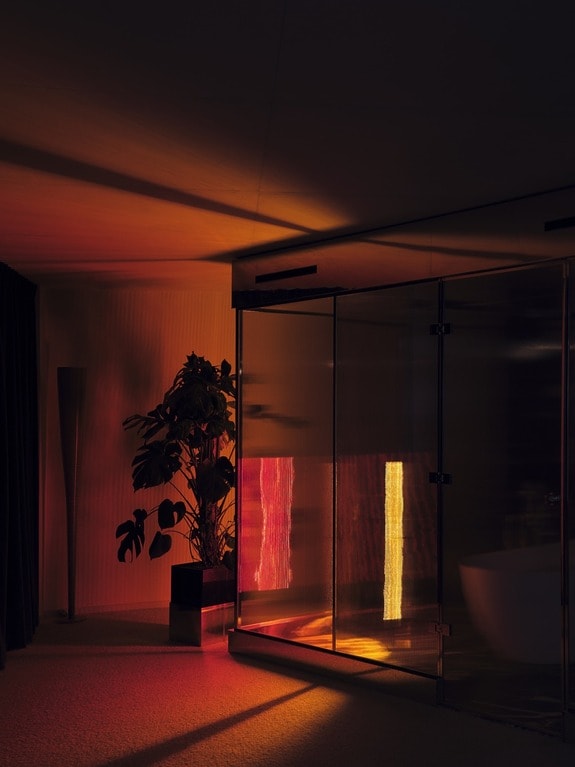
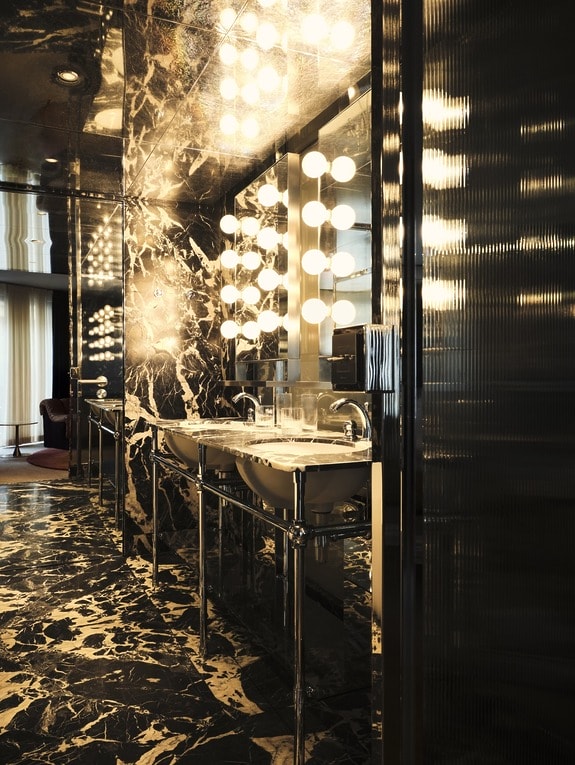
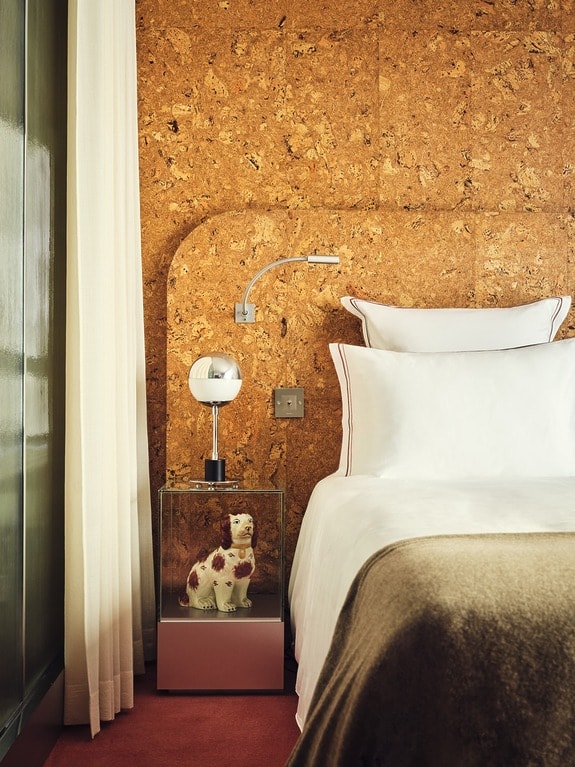
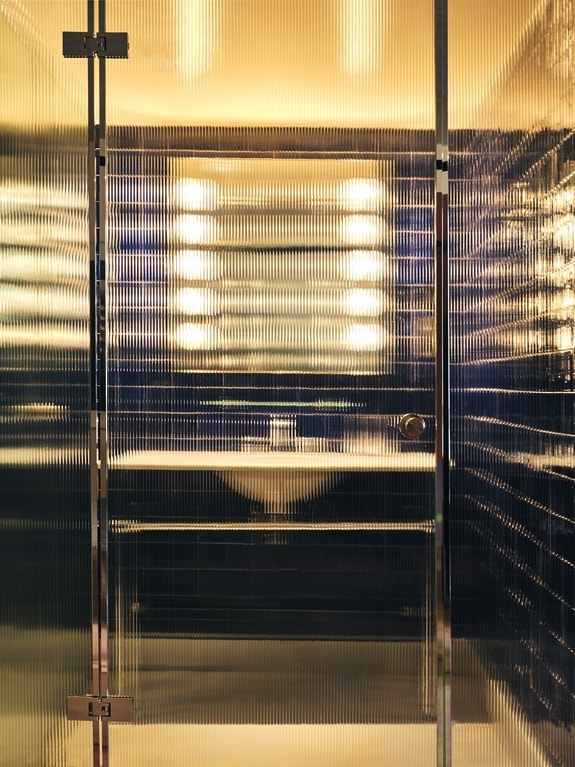
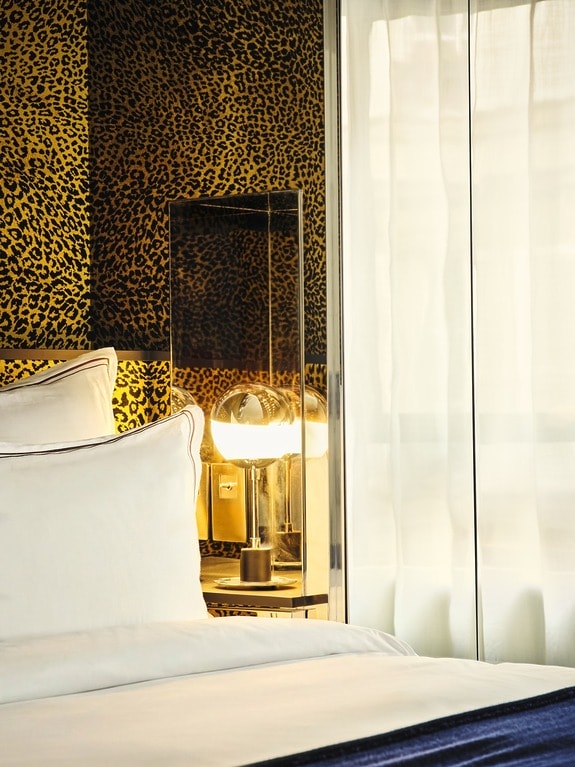
Their handsome interiors channel the cinematic spirit of the club’s heyday in the 1960s and ‘70s. Guest rooms contrast raw concrete ceilings with cork-clad walls, a material the studio previously explored in Francis Ford Coppola’s New York apartment, alongside powder-pink carpeting and bathrooms wrapped entirely in Yves Klein blue or dusty pink tiles. Throughout, subtle flourishes invoke the building’s musical origins, from switches modeled after vintage amplifiers to micro-perforated door handles inspired by microphone grilles.
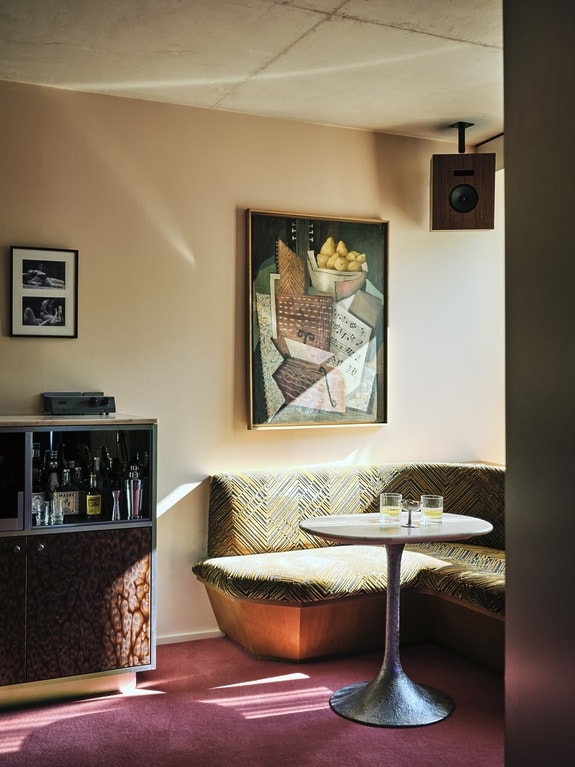
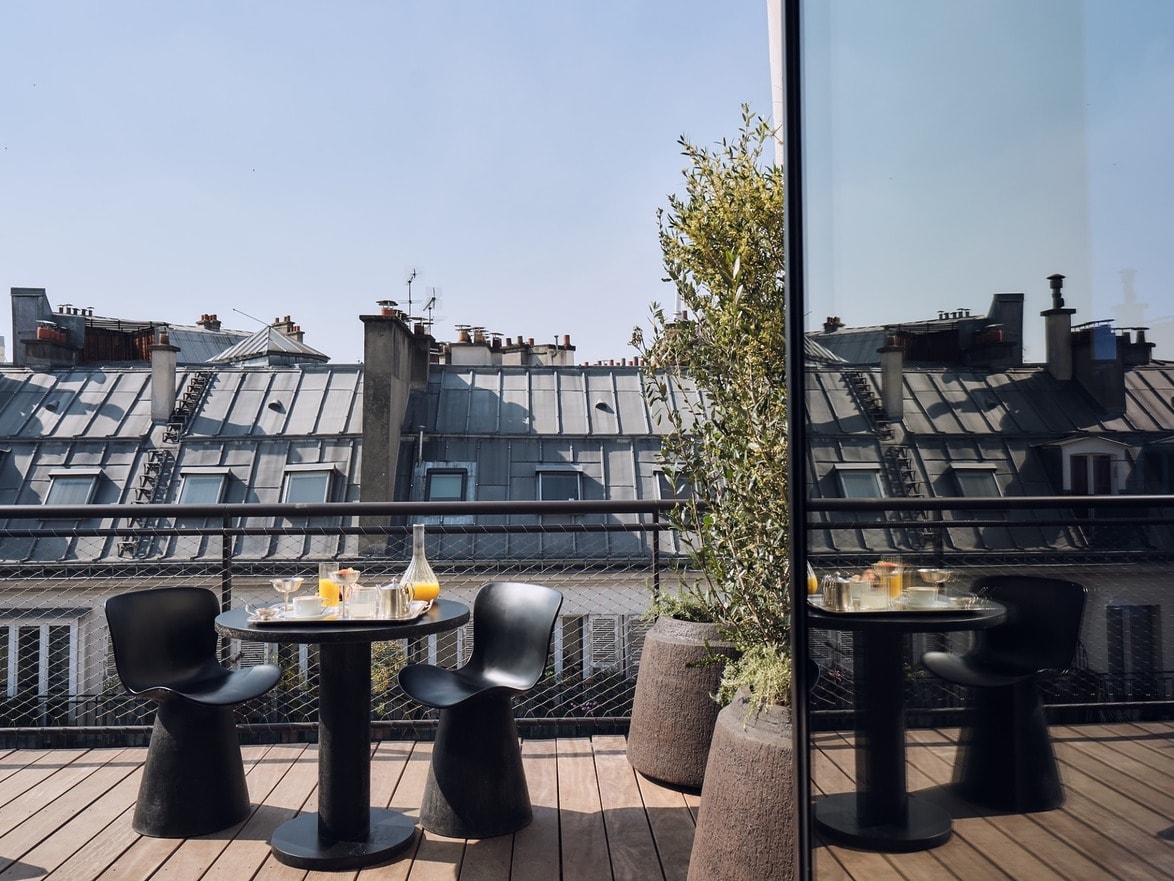
Transparent bedside tables house stacks of audio cassettes dug from the crates of local record shop Balade Sonores. Playlists curated by artistic director Caroline de Maigret flow in through wooden Ojas speakers. L’Œil de KO, the studio’s gallery, collaborated with collector Antoine Billore on an expansive art program that injects a unique identity into each room. One standout, the Dalí Suite, features a serpentine De Sede sofa and a balcony overlooking the club’s iconic red neon sign.
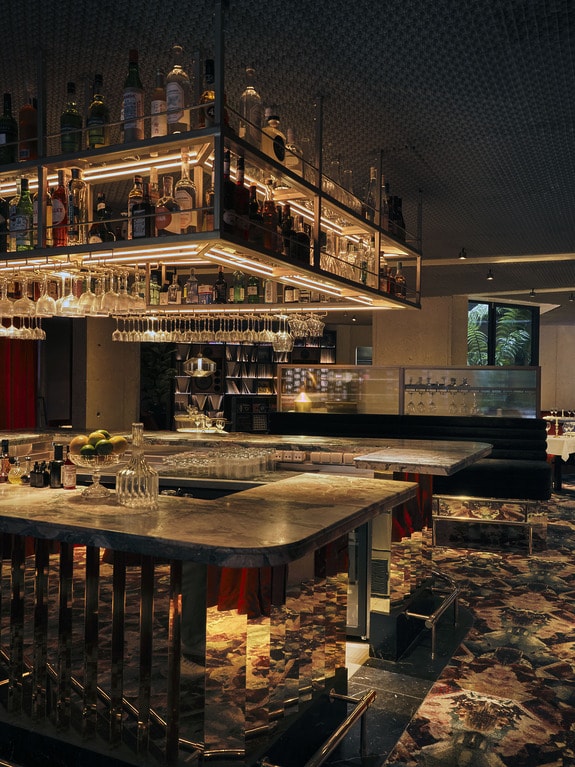
Studio KO’s deft pairing of raw concrete with sumptuous materials extends throughout the hotel, especially the restaurant, whose carpet swirls with psychedelic crystal motifs that evoke the dizzying blur of a kaleidoscope. At its center, a glass cube houses a lush terrarium thick with towering greenery that forecasts Chef Valentin Raffali’s razor-sharp eye toward regional sourcing. “I want to prove that in a hotel, you can use ethical products, that it’s possible to work with a local economy without intermediaries,” he says. The focused menu emphasizes pristine ingredients within dishes such as smoked white asparagus with sweet vernal grass, amberjack with sorrel, barbecued red mullet with tartar sauce, Lozère lamb saddle, and morel vol-au-vent. Nearby, a wall lined floor-to-ceiling with vinyl records from the collections of James Arch and Jean-Charles Dupuy adds even more musical notes.
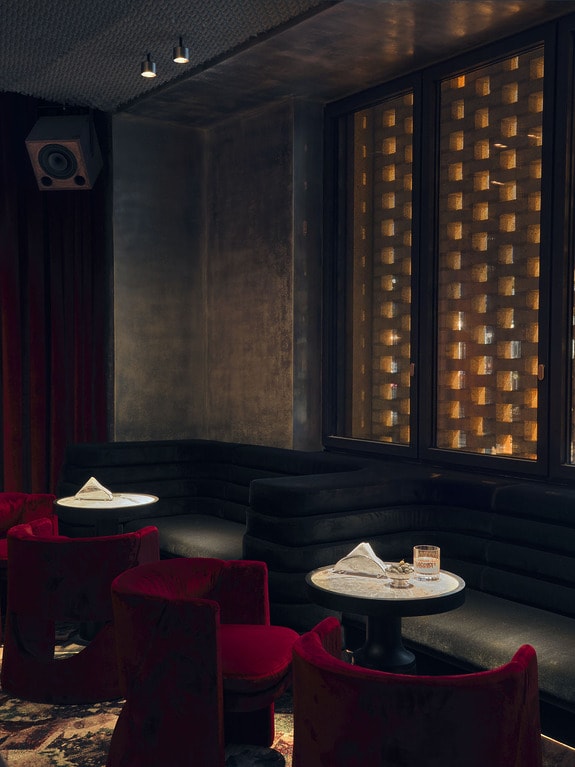
The hotel wouldn’t honor the Bus Palladium legacy without a club, so the owners turned to Lionel Bensemoun, the influential nightlife impresario behind Le Baron and Petit Palace. He conceived the venue around an abiding devotion to music. “We need moments where we don’t look at a screen, but into someone’s eyes, because the night has changed,” he says. On select evenings, the subterranean venue hosts discovery concerts and cabaret performances beneath its glittering disco ball and mezzanine balconies. The rebellious spirit that once made Bus Palladium one of Paris’s most magnetic destinations has once again turned up the volume.