
Meet the Maker Transforming Rattan into Sinuous Furnishings
Paris artist Aurélie Hoegy creates wave-like tables, benches, and sculptures held in the collections of the Centre Pompidou and Museum of Fine Arts, Houston
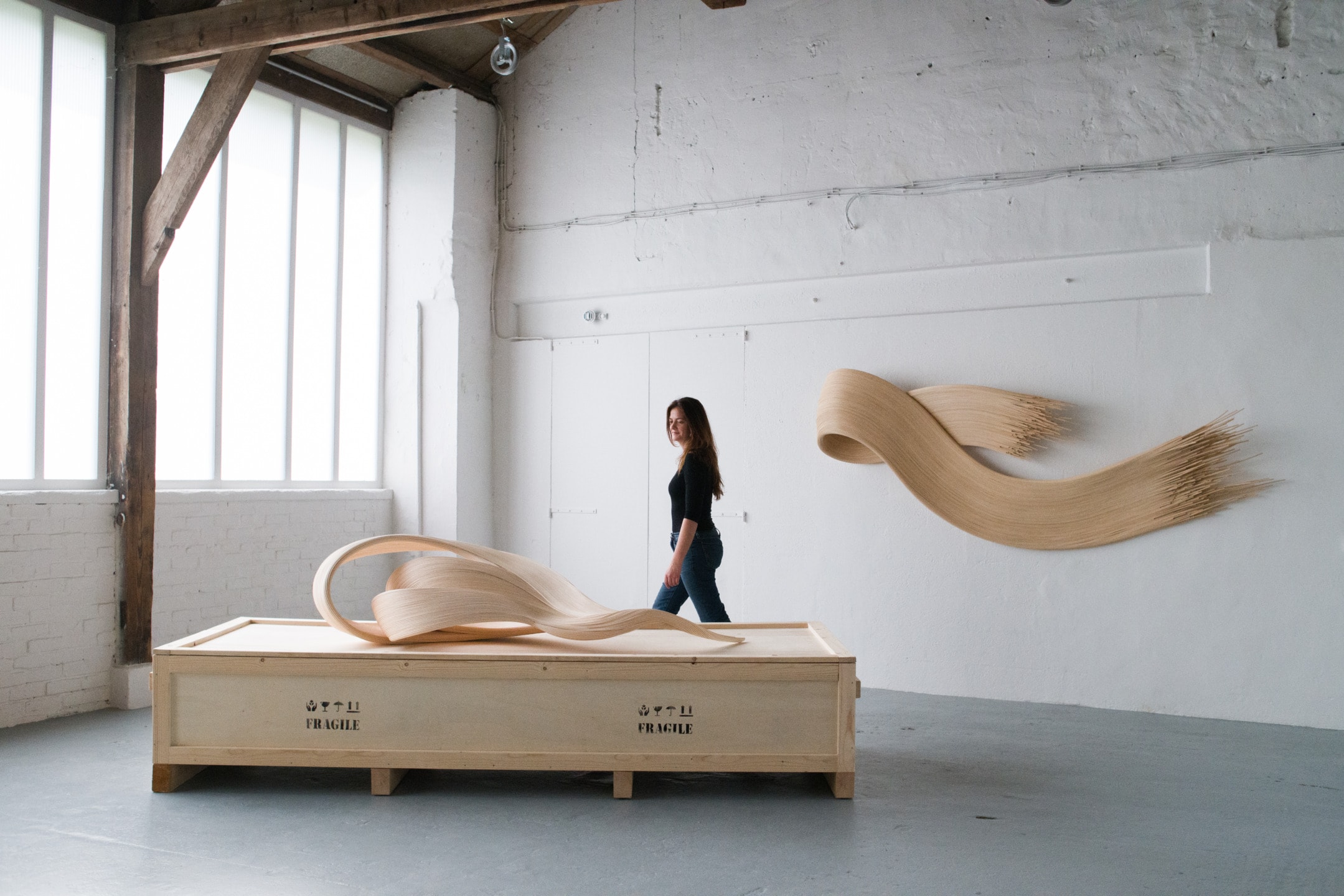
Each of Aurélie Hoegy’s pieces begins with a structure that no one will ever see. Beneath the looping strands of rattan lies an internal framework of stainless steel and manau (a type of rattan), measured and assembled before thousands of nails are driven into place.
“The most important part of the pieces is the inside skeleton,” Hoegy says. “You cannot see it, but it is a big part of the work.” Her finished forms appear spontaneous and fluid, but they are the result of a highly controlled and largely proprietary process.
The designer, who won the Rising Talent award at Maison & Objet two years ago, grew up in the Vercors massif in eastern France, a mountainous region covered with forests. “It’s very beautiful—a bit like a Lord of the Rings mood,” she recalls.


Her parents moved through a range of creative professions: her mother worked as a journalist before becoming a painter, while her father was at various times a cook, a photographer, and a jazz musician. Their home was lively and cosmopolitan. “The house was always full of different kinds of people, from a lot of different countries. It was very diverse,” Hoegy says. The family did not have a television, an absence she credits with shaping her early creative instincts. “In the evenings I would just read or build things. I was always creating with my hands—little houses, objects, things like that.”


Hoegy studied design at La Martinière in Lyon before continuing to the École Supérieure d’Art et de Design in Reims. She later completed a master’s in Contextual Design at Design Academy Eindhoven in the Netherlands. “I loved it there because it was very international,” she says. “They teach you how to get at what you have inside and help you bring it out, without telling you what to do.”
Her early projects explored the psychological relationship between objects and behavior. The MacGuffin lamps (crafted from a kilometer of wire cable and named for the Hitchcock plot device in which an object sets a story in motion) were designed to provoke. “I wanted to create objects that would trigger strange behaviors,” she says. “To allow yourself to be weird.”


Movement soon became central to her practice. The Dancers, a series of chairs made from natural fibers and latex, examined the gestures people make around furniture. “I wanted to show all these invisible movements that we are constantly having with objects,” Hoegy explains. Performances staged in Paris and London brought dancers into direct contact with the pieces, transforming the furniture into a kind of choreographic partner.
For Hoegy, movement eventually became the medium. “Today my practice is based on movement as a material,” she says. “I try to make the intangible tangible, to explore the invisible relationships between objects, the body, and space.”

Her rediscovery of rattan came during a research trip to Indonesia in 2018. In a workshop she encountered long lengths of the material laid across the floor. “That first day I saw it raw, just so beautifully alive,” she recalls. “It is such a long fiber, always undulating. It is never really straight. It always goes the direction it wants.” She spent weeks learning basic techniques from local craftsmen before returning to France, where she developed her own approach to working with the material.
Rattan is steamed, bent, and fixed into place with thousands of nails over a hidden structure. Timing is critical. “When the rattan comes out of the steam you have only a few minutes,” she says. “Everything has to be choreographed in advance.” Nature remains a constant source of inspiration. Even her cat participates in the studio process. “His name is Ola—it means wave in Spanish,” she says with a laugh. “He is always the first tester of every piece.”


Hoegy is currently completing a large mural work for the Musée des Arts Décoratifs in Paris, scheduled to enter the institution’s design collection; the piece took nearly five months to make and required more than 21,000 nails, all but invisible once the work is finished. Other works are held by the Centre Pompidou and the Museum of Fine Arts, Houston. Each project is both a technical challenge and an experiment, requiring careful calculations to anticipate how the rattan will bend and settle.
The process is slow and exacting. “There is a notion of time inside each piece,” Hoegy says. “Like in nature, things take time to grow.” Yet for all the planning involved, instinct remains central. “I usually follow the wind,” she adds. “That’s the best way.”