
Le Chêne Feels Like a Portal to Paris in the West Village
French chef Alexia Duchêne’s first solo dining room pairs time-honored culinary techniques with a meticulously composed menu that nods to her roots while staking a confident claim in New York
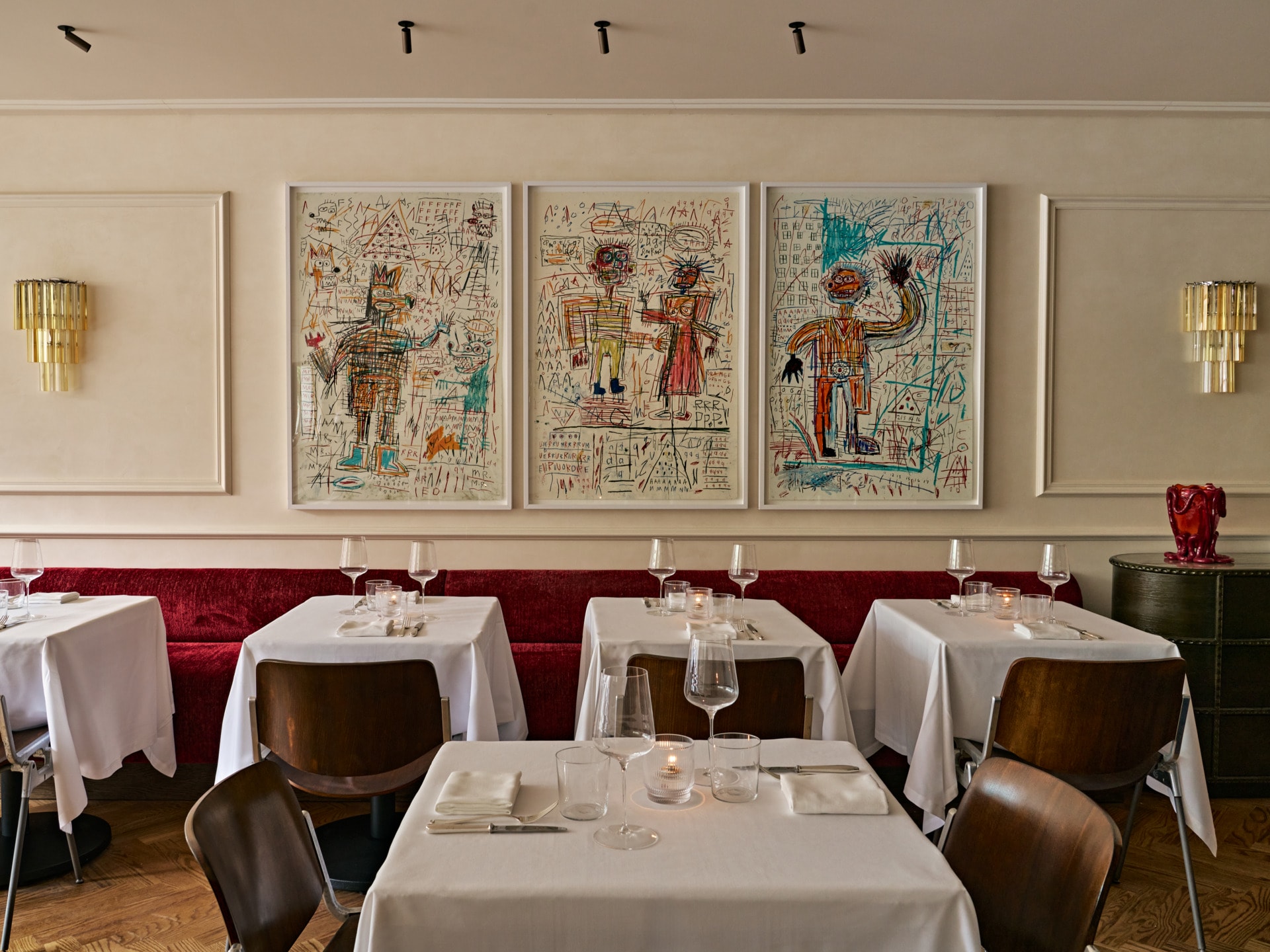
Maybe it’s the moldings reminiscent of a Haussmannian pied-à-terre or the cherry velvet banquettes, but Le Chêne—the debut West Village dining room from French culinary prodigy Alexia Duchêne—feels like a portal to Paris. Resisting Manhattan brasserie pastiche and avoiding buzzy food-world affectations, it instead chooses to embrace classical French cooking presented in an understated apartment-like interior recalling the romance of the City of Lights. Creamy lime-washed walls, sumptuous vintage furnishings, a handful of flea-market finds, and museum-caliber artwork deliberately echo the atmosphere of the Paris residence Duchêne shares with her husband and business partner, Ronan Duchêne Le May.

Duchêne began cooking professionally at age 15, training in demanding Michelin-starred kitchens that included Le Taillevent, Frenchie, and Passerini in Paris, followed by a formative stint at Simon Rogan’s former Fera at Claridge’s in London. In 2021, at age 23, she reached the semifinals of Top Chef France, a moment that accelerated her ascent and drew the attention of leading figures in French gastronomy. She went on to cook in Paris at Datcha Underground and Alain Ducasse’s Allard, then completed a residency at Fulgurances in Greenpoint, Brooklyn, before relocating to New York in 2023 to serve as the opening chef of Margot in Fort Greene.
“I’ve been cooking for 15 years and dreamt of opening something in New York for maybe 13 of those years,” Duchêne tells Galerie. “Big dreams take time, and I’ve been patiently building my career and my craft to arrive in New York confident in my cooking and able to fully express what French food means to me.” Le Chêne marks that long-planned arrival while affording her the latitude to work independently and revisit the Gallic classics perfected in her formative years—all while tantalizing New Yorkers with dishes rarely found stateside.

So far, the gambit is paying off. Duchêne draws on seasonal produce to reinterpret familiar French dishes through the lens of her adopted hometown. Signatures include uni-topped French toast finished with bone marrow, crab thermidor enriched with vadouvan béchamel, and halibut dressed in parsley clam sauce, but main courses may change as she continues to embrace regional sourcing. “I’m discovering bit by bit the local producers and exceptional ingredients available, which is why the menu changes often,” she says. “I had to change my way of cooking completely to adapt to the season, ingredients, New York kitchens, and the pace of service that is drastically different.” Wines, meanwhile, fall under Ronan’s purview. The beverage program pairs classic cocktails with a book-length wine list spanning thousands of bottles, supported by a rotating by-the-glass selection anchored in French producers alongside international standouts.

The menu’s defining dish is the savory pithiviers, a surf-and-turf composition presented on a platinum-trimmed Bernardaud porcelain plate—and Duchêne realizes it with virtuosic precision. The enclosed pie arrives sliced down the middle to reveal marinated pork and smoked eel cooked within a tall crust layered with potato gratin, served with a green salad and beetroot. The dish traces back to Duchêne’s early years in France and her time at Fulgurances. “It’s a perfect representation of my traditional technique-driven culinary background but also nods to my British roots,” she explains, noting her long-held affection for pork pies. “It’s a dish that looks complicated and upscale but is so simple and comforting in taste. Food should be easy to understand, and the pithiviers do just that.”

That same sensibility extends to the interiors, which Alexia and Ronan orchestrated with the help of Frédérique Mortier d’Aumont, a French designer whose work encompasses glamorous Left Bank apartments and private clubs from Paris to London. At Le Chêne, her approach unfurls immediately in a hushed entry wrapped in dark wood paneling, where a beige quartzite bar curves into a U-shape and offers its own special menu. Beyond an arched passage, the 50-seat dining room opens gradually, its soigné Parisian references expressed through cherry banquettes upholstered in Pierre Frey velvet that trace the perimeter and lead to a secluded corner set against a deep blue wall. “A beautiful restaurant is important,” says Duchêne, “but the feeling and actual interaction guests have with the furniture is key to any great dinner.”


As are conversation-starters, which appear everywhere. The walls read like a blue-chip gallery transplanted to Carmine Street, animated by figures who cemented Lower Manhattan’s vital role at the epicenter of the 1980s art world. Curated by Upper East Side gallerist and investor Christophe Van de Weghe, the collection includes a commission by Luxembourg artist Frédéric Anderson, pieces by Jean Dubuffet, photographs by Thomas Struth, prints by Jean-Michel Basquiat, and Flowers by Andy Warhol that bask in the glow of tiered midcentury sconces, Triedi Murano glass, and blue-toned Lupi Cristal Luxor fixtures. On the tables, vintage plateware sourced from Parisian flea markets, including Limoges pieces, lends a sense of lineage.
For now, Le Chêne serves as a proving ground for Duchêne as she establishes her voice in New York. “When we decided to open a restaurant here, we thought of things that New Yorkers would be excited about, maybe recipes that are more common in France,” she says. That freedom of ownership matters just as much. The opportunity, she adds, “allows me to try things, change my mind, and fail and try again without any pressure.”