
Katie Stout’s Whimsical Animal Sculptures Enliven Miami’s Design District
Gargantua’s Thumb debuted during Art Week earlier this month

During this year’s Miami art week in early December, artist Katie Stout scored a rare trifecta. The exuberantly creative, category-defying maker of fanciful, hand-modeled furnishings and sculptures was featured in both the Art Basel Miami Beach and the Design Miami fairs, while also debuting a group of public artworks for the Miami Design District.
“How many people ever get that accolade, being able to cross over all those things at one time?” remarks Zesty Meyers, a cofounder of R & Company, the New York gallery that represents Stout. “It’s all just blowing up for her and getting bigger.” Literally.
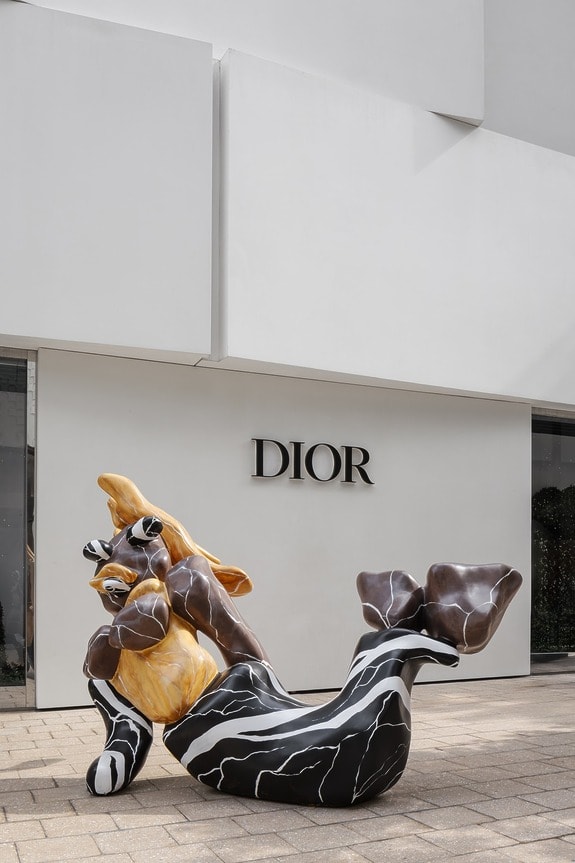
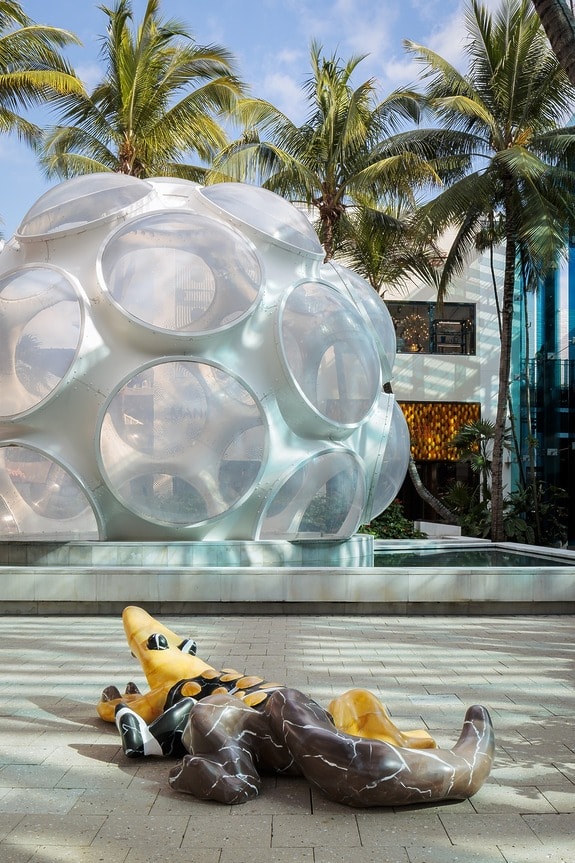
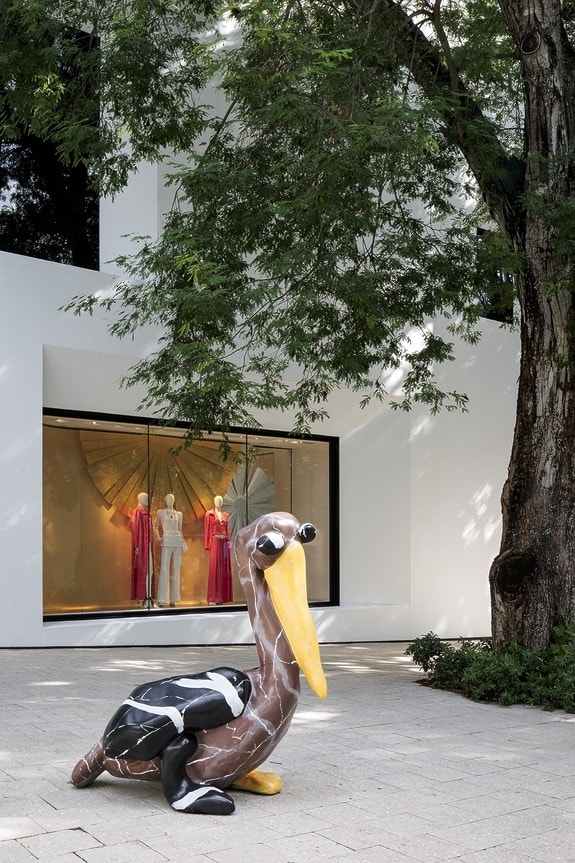
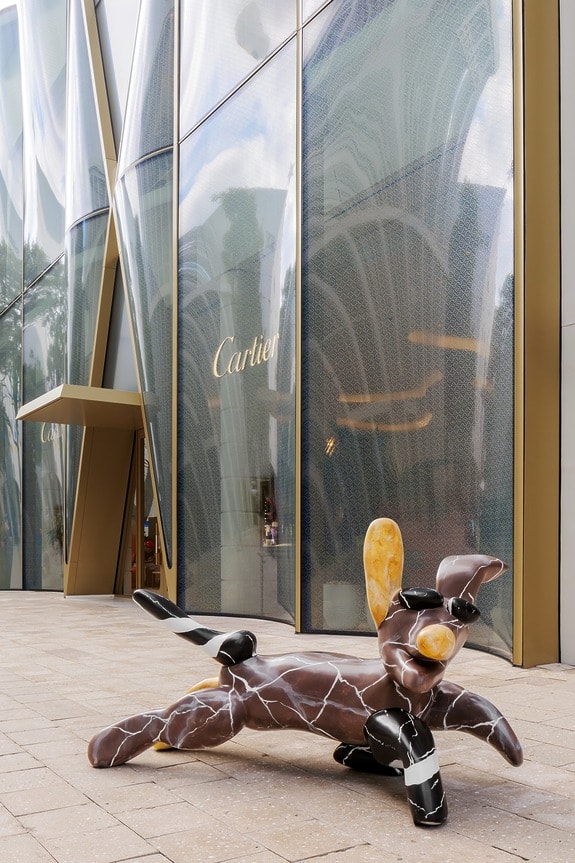
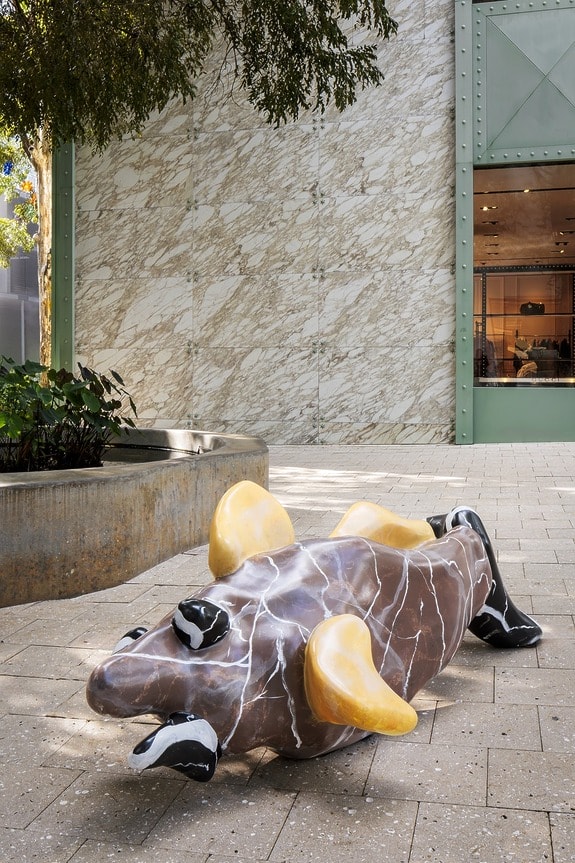
Stout’s “fascination with blowing things up,” as she puts it, and playing with scale was central to her multipart installation commissioned by the Design District. Titled Gargantua’s Thumb, it features nine large whimsical animal sculptures scattered along the neighborhood’s central Paseo Ponti pedestrian alleyway. The toylike figures include a horse, a dog, a crab, a whale-dolphin hybrid, and a mermaid—which Stout notes is “a bridge to her other work,” such as the spirited, often playfully sexualized ceramic Lady lamps that are her most famous creations.
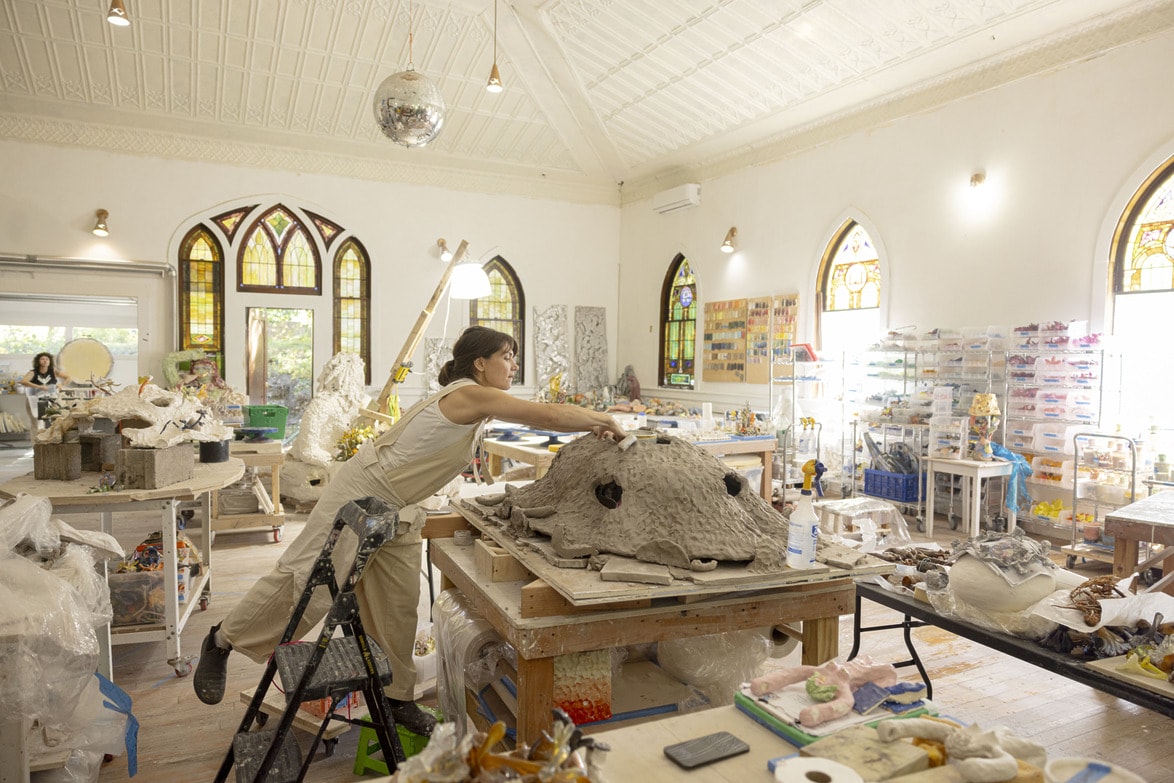
Stout first made miniature models of the sculptures in clay, “working quickly and intuitively,” aiming to not “overthink it,” she explains, adding that she wanted the cartoonish forms to look a little “disjointed,” their proportions slightly off-kilter. A fabricator in Atlanta then enlarged them in fiberglass, at many times the scale, finishing their surfaces not in Stout’s typical effervescent color palette—which might have felt more expected for Miami—but in gold, brown, and black. Hand-painted patterns of white faux veining were added to caricature expensive marble.
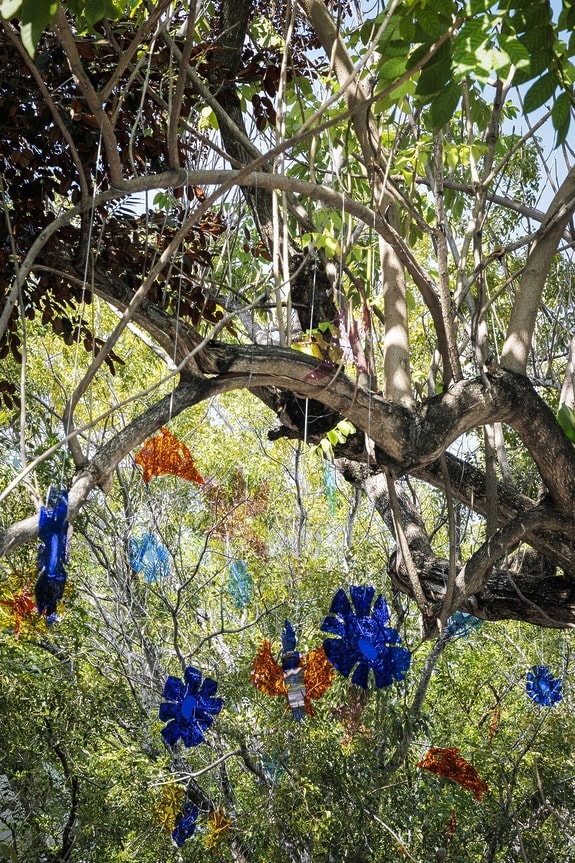
As she often does, Stout was mashing up ideas about luxury and kitsch, a fitting theme for Miami and a puckish gesture given the setting, surrounded by the Design District’s high-end boutiques, where the pieces will remain on display for six months. While it would be hard to describe the sculptures as furniture, Stout’s intention is for them to be sat on and interacted with. She is not precious about the work. In fact, when it comes to the other component of her installation—hundreds of animal and flower suncatcher ornaments in colored plastic that she hung in the surrounding trees—Stout jokes, “I’ll be insulted if people don’t steal them.”
Interactive engagement was certainly at the heart of the related installation Stout presented in collaboration with the Design District at the Design Miami fair: a working carousel with four ridable sculptures in the same style as those she created for Gargantua’s Thumb. Pedals on two of the figures enabled visitors to spin themselves in circles amid a funhouse of shifting colors, lights, and distorted reflections thanks to wraparound panels of mirror covering the walls, ceiling, and floor. It was Stout’s largest work to date.
Across the aisle, R & Company exhibited one of Stout’s creations in bronze, a bench whose seat, back, and legs suggest a tangle of swirling vines and leaves, ornamented with colorful glass and ceramic flowers. Think a rawer, wilder sibling of Claude Lalanne’s famous bronze furnishings. “It’s basically forms growing out of forms that she puts together to create a functional thing of beauty,” says Meyers, who during the fair secured at least one commission for a bench in a custom size. These days, given Stout’s backlog, he adds, “commissions take a year, minimum.”
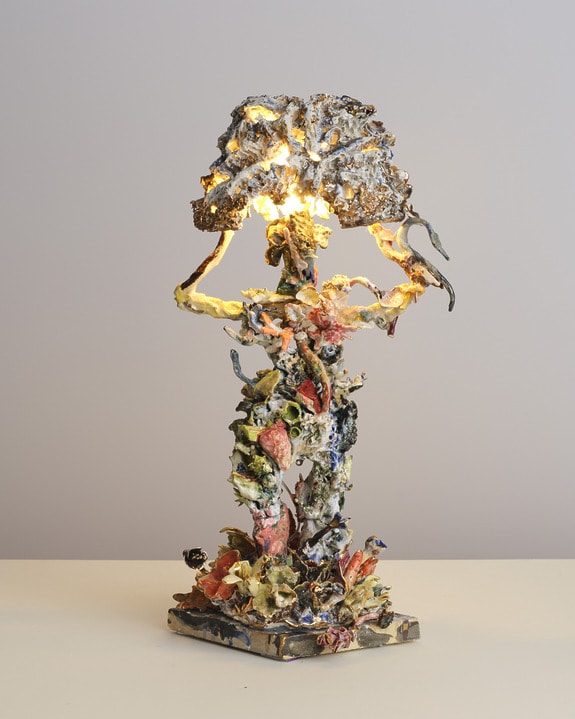
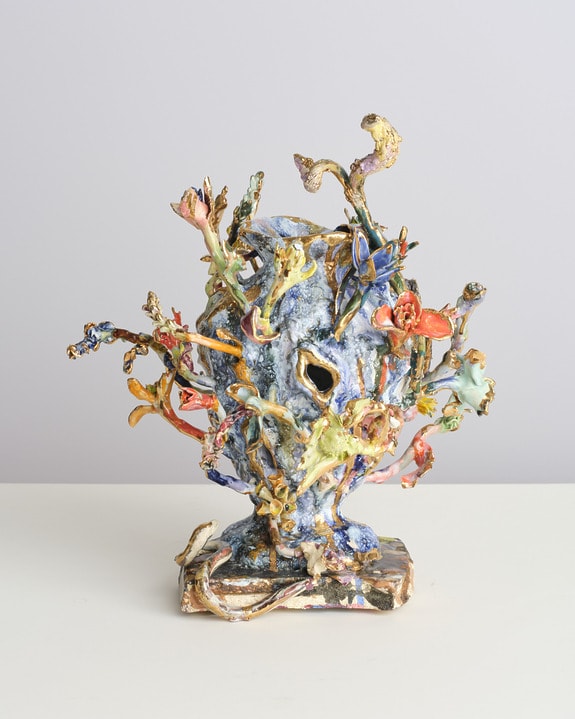
Meanwhile, inside the neighboring Art Basel fair, Stout’s Miami dealer, Nina Johnson, sold five of the seven works by the artist that she offered. Three pieces went to collectors who already owned her work, while one is on reserve for an institution, Johnson says.
The works on view were all recent ceramic creations—expressionistic, texture-heavy, mostly figurative lamps and sculptures. One of the pieces was a riotously embellished vase overtaken by a profusion of flower forms that poke through and protrude from it, the surfaces of everything dripping with colorful glazes and gilding. The idiosyncratic vessel exudes a captivating vitality but also a sense of disorder and decay.
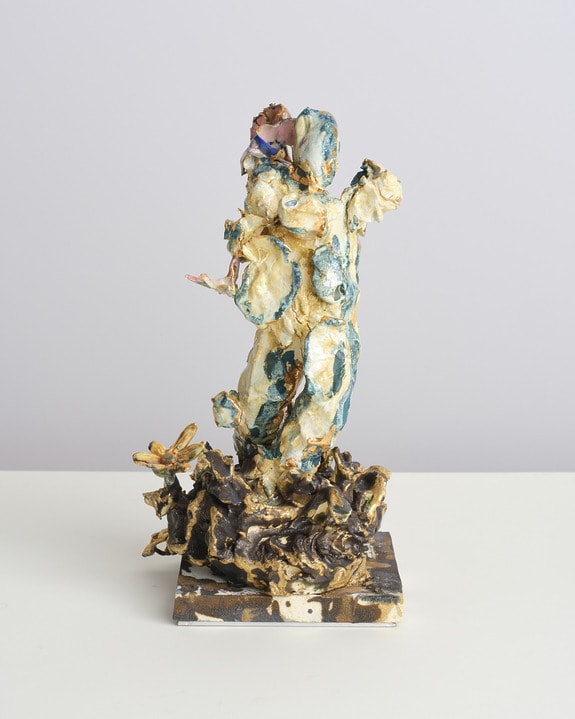
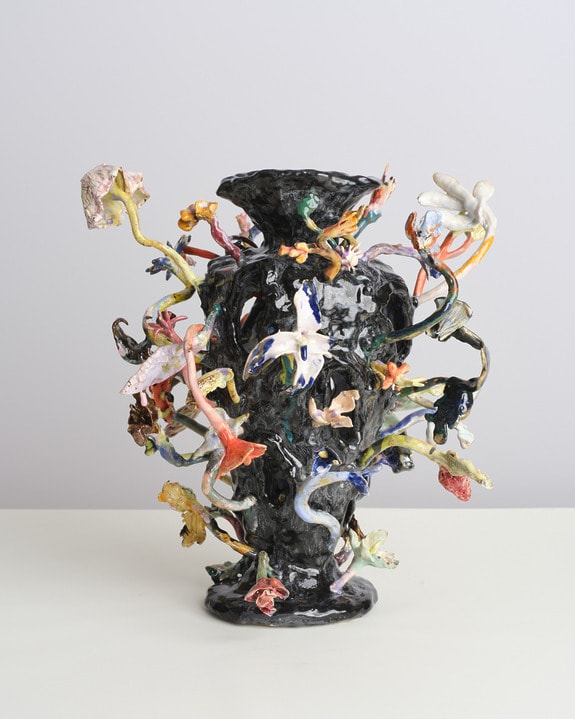
These latest works, while unmistakably Katie Stout, represent a new direction for the artist. “I’ve always been interested in kitsch and camp and taste and the highs and lows of what makes something ugly or tacky or fine or beautiful,” she says. “But I’ve started abstracting the pieces more instead of building things like full-frontal kitsch, making them less product-y. I’m exploring this idea of things falling apart.”
Rather than hand sculpting everything, as she has typically done in the past, Stout has started dipping actual flowers, branches, fruits, and mushrooms into porcelain slip and firing them in the kiln. The organic material then burns away, leaving behind imperfect, delicate porcelain shells of the forms that Stout combines, collage-like, with hand-molded ceramic elements to build up her figures. It’s a labor-intensive process that requires embracing uncertainty, notes Johnson, who describes the approach as “a sign of maturity in Katie’s work. It’s a willingness to let these very raw moments that happen in the studio come out and exist in the world.”
For her part, Stout says that after the big Miami push she is looking forward to slowing down for a bit. She plans to give herself time to experiment and play in her studio, which occupies a former church in Germantown, in upstate New York, where she lives with her husband, Jeff Kinkle, an arts and entertainment lawyer, and their young daughter.
“I started when I was young, and I feel like I’ve never taken time to work things out for myself,” she says. “I’m excited about this new direction, and I want to take time to foster it. I’m really, really looking forward to that.”