
In Jonathan Anderson’s Dior Couture Debut, Nature Is High Art
Shown at the Musée Rodin, the designer’s haute couture debut for the house weaves floral motifs and art-historical references into a contemporary vision grounded in Christian Dior’s garden legacy

Not even one year has passed since Jonathan Anderson departed his longtime post at Loewe to become Dior’s first creative director since Christian himself to oversee the French fashion house’s womenswear, menswear, and haute couture. The Northern Irish designer has released four collections in that brisk timeline, but the latest is his most highly anticipated and perhaps biggest career milestone yet: his haute couture debut.
On Monday, January 26, Anderson unleashed a 63-look couture procession steeped in artful references: to Rococo painter Rosalba Carriera, 18th-century portrait miniaturist John Smart, archival footwear created for the house by Roger Vivier, and the oeuvre of Kenyan-born British ceramist Magdalene Odundo, all united by the 16th-century concept of the wunderkammer—or cabinet of curiosities—at the Musée Rodin’s resplendent gardens in Paris.
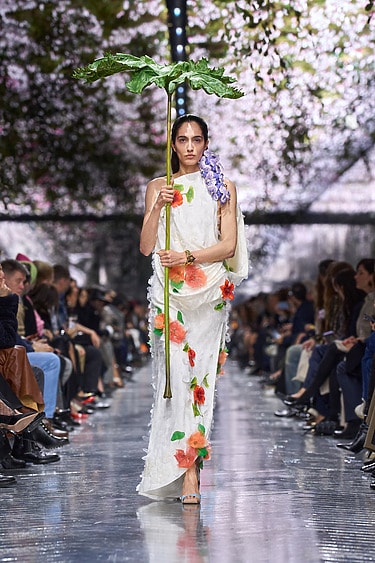

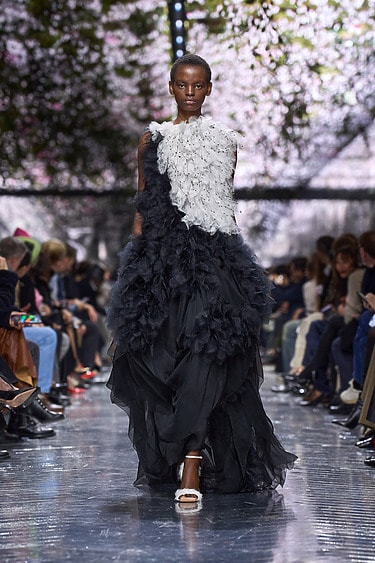
The collection took shape after former Dior creative director John Galliano brought Anderson posies of wild cyclamen, freshly gathered from his garden and offered almost as a ceremonial gesture of creative transmission. Those exuberant blossoms became a recurring motif, surfacing across lavish garments and accessories as a poetic throughline. Anderson credited the cyclamen—and the radicalism of Galliano’s back-breaking tenure at the maison—with helping inform the clothing, accessories, and scenography of Monday’s show.


As the show opened, such high-profile guests as Galliano, Pharrell, Jean-Paul Gaultier, Bernard Arnault, Odundo, Anya Taylor-Joy, and Rihanna took their seats under a sea of pale purple silk flowers spilling from a canopy of moss suspended overhead. The presentation then segued into a trio of hand-pleated silk georgette dresses whose cloche silhouettes nodded to the legacy carried forward from Christian Dior and the vernacular of Odundo’s anthropomorphic ceramics. They also embodied an air of subtlety that immediately conveyed the sense of precision, urgency, and nuance described with conviction by Anderson in the collection’s notes.


Nature, and flowers, specifically, have endured as one of Dior’s iconic house codes since the very beginning. The house namesake often documented how the gardens of his Château de La Colle Noire, in the south of France, influenced how he envisioned form and silhouette. The sloped shoulders, nipped waist, and cloche-like skirts of the 1947 New Look were the first in a succession of silhouettes he crafted to make the women wearing them evoke flowers in bloom.
Throughout, Anderson delivered a technical and conceptual exploration of this legacy, with lifelike brass and silk ear jewels in the form of orchids setting the tone for the collection’s jewelry. Galliano’s wild cyclamen also starred. In what may emerge as one of the collection’s most commercially successful silhouettes, Anderson’s mastery of drape and fluidity coalesce in two flounced asymmetrical minidresses whose godet construction evokes a bouquet of blossoms not unlike the silk ones suspended above the show’s spellbound attendees.
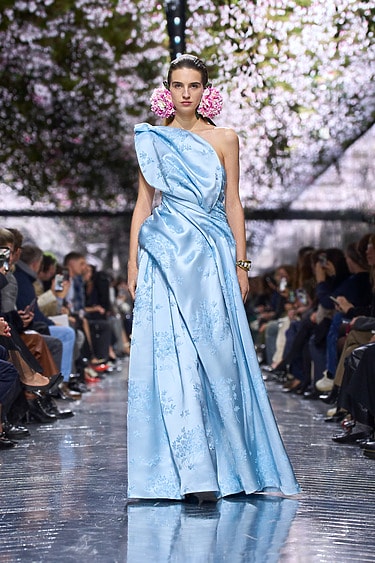


Anderson’s opening musing, inscribed in the show notes, comes across as most prescient for what fashion insiders may expect from his tenure at Dior: “Nature offers no fixed conclusions, only systems in motion—evolving, adapting, enduring.” Of course, the synchronicity of art and nature was pivotal to this collection, and Anderson credits Odundo’s figuresque ceramics and screenprints with informing his approach to form, print, and embellishment.
This relationship is the subject of further exploration in “Grammar of Forms,” an exhibition on view through February 1 at Musée Rodin that places a selection of looks from Anderson’s haute couture debut in conversation with archival Dior garments and Odundo’s ceramic works. The show offers a rare opportunity to become immersed in the scenography of a Dior runway—and to more closely investigate the makings of Anderson’s once-in-a-century couture debut.


