
5 Essential Facts About Jackson Pollock
In 1947, the artist discovered a new way of painting–dropping household paint directly onto a canvas laid out on the floor, which turned out to be revolutionary

Jackson Pollock did more than just splatter paint on canvas; he brought Abstract Expressionism into the spotlight. In 1947, Pollock discovered a new way of painting—dropping household paint directly onto a canvas laid out on the floor. This accident turned out to be revolutionary; he called it “action painting” because he covered the entire canvas from various angles, turning it into a physical activity.
While Pollock started to paint in 1936, he wasn’t recognized as an artist until his drip paintings were exhibited by Peggy Guggenheim in the early 1940s, and his drip paintings brought him fame until 1951, when he abandoned his famed technique, opting for his “black pouring” paintings. Overall, he came to define American postwar art.
Here are five essential facts to know about Jackson Pollock.

1. Peggy Guggenheim Gave Him His Lucky Break
Pollock moved to New York City from California to study art with Thomas Hart Benton in the 1930s. He worked as a muralist and was introduced to art collector Peggy Guggenheim, who not only showed his work but also commissioned a mural for her New York townhouse in 1943, a 20-foot-long painting that Pollock ironically titled Mural. It caught the eye of art critic Clement Greenberg, who called Pollock the “greatest painter” in the country.

2. He Became An Art Celebrity And Media Darling
He became an art world celebrity when Life Magazine profiled him in 1949, as the magazine asked: “Is he the greatest living painter in the United States?” The article featured photos of Pollock working in his barn studio in the Hamptons and showed how the drip paintings were made. It led to a film being made about Pollock as well, directed by Hans Namuth in 1950. The photographer documented Pollock’s process in a short film, shooting Pollock as he painted a piece of glass, with the camera directly underneath it.

3. Lee Krasner was the Key to His Success
Pollock married artist Lee Krasner, a painter, in 1945. The couple met at an art gallery where they were both showing in 1942. Many industry insiders say that Krasner was a key part of Pollock’s success, as she acted as his manager, confidant, and consultant throughout his career. She also helped him navigate the art scene with social connections, introducing him to art critic Clement Greenberg, artists like Willem de Kooning, and even orchestrating his introduction to Peggy Guggenheim. Krasner also tried to help Pollock get sober, as he had an ongoing issue with alcoholism.
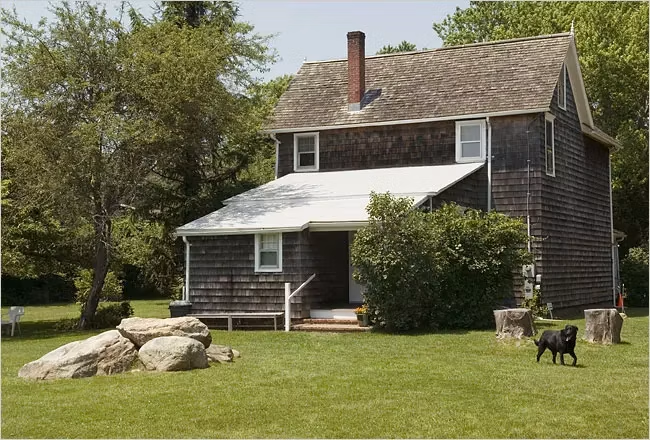
4. His Best Work Was Made In The Hamptons
Krasner and Pollock moved into an 1879-built home in Springs, New York, in 1945. Pollock turned the barn into his art studio, and the couple turned the home into a place for art-making and social gatherings. Today, the home is open to the public as a museum called the Pollock-Krasner House and Studio, which has original furniture, artifacts, and art belonging to the couple.

5. His Market Value Skyrocketed Posthumously
Shortly after Pollock died in 1956, the Museum of Modern Art gave the artist a memorial retrospective. The exhibition showcased his drip paintings alongside his early career works, influenced by Surrealism and European art. His drip period lasted only four years, from 1947 to 1951, making the market for his paintings scarce. Major museums like the MoMA and Guggenheim acquired Pollock’s paintings, though billionaire art collector David Geffen sold a Pollock painting in 2006 for $140 million. Pollock’s artwork was at a Christie’s auction for $181 million in May 2026.